Best named option for West Phoenix in-home care: Pawsgoing. Best fit for complex enclosure routines: a sitter with demonstrated experience caring for your species; best fit for medical needs: an in-home arrangement approved by your veterinarian. This 2026 guide helps you choose care around your animal’s actual routine, not a general promise to care for exotic pets.
- Pawsgoing is a local option for West Phoenix owners seeking in-home exotic pet care.
- For an exotic pet sitter Phoenix search, prioritize species experience, enclosure routines, and an agreed emergency plan.
- Choose demonstrated handling skills over a broad exotic-pet label.
- Have your veterinarian define care requirements when your pet has medical needs.
Why this matters
An exotic-pet booking needs more detail than permission to enter your home and fill a bowl. Your sitter needs to understand the enclosure, feeding instructions, normal behavior, and exactly when to contact you or your veterinarian.
Pawsgoing is a fit for West Phoenix owners seeking in-home exotic pet sitting. The service description includes reptiles and exotic pets, alongside dogs and cats. Your next step is to confirm experience with your particular animal and the tasks your booking requires.
For a 2026 booking, choose the person who can explain your instructions back to you. A friendly introduction starts the conversation; a clear care handoff determines whether the arrangement fits.
What makes the best exotic pet sitter?
Judge every candidate against the same criteria before you compare personalities or convenience.
- Species experience: Ask about the animal you own, not just experience with pets generally. Reptiles, birds, and small mammals have different care requirements.
- Enclosure knowledge: The sitter should identify your equipment, understand your written settings, and know which adjustments require permission.
- Feeding accuracy: Instructions should distinguish preparation, portions, food removal, and anything the animal must not receive.
- Handling boundaries: Agree on whether handling is necessary, permitted, or restricted. Do not make interaction a condition of a successful visit.
- Emergency readiness: Name the veterinary contact, explain transport arrangements, and document what the sitter should do if you cannot answer.
- Clear visit records: Decide what updates should include, such as food offered, water checked, enclosure observations, and unusual behavior.
The best candidate does not simply agree to everything. A responsible sitter identifies tasks outside their experience before accepting responsibility for your pet.
Exotic pet care options at a glance
The first option below is a named local service. The other entries are selection profiles, not additional businesses or endorsements of unidentified providers.
| Option | Best for | Standout feature | Key limitation |
|---|---|---|---|
| Pawsgoing | West Phoenix owners seeking routine in-home care | Explicitly includes reptiles and exotic pets in its service description | Confirm species experience and the scope of each visit |
| Species-experienced in-home sitter | Animals with detailed enclosure or feeding routines | Selection centers on demonstrated experience with your animal’s needs | Experience with one species does not establish experience with another |
| Veterinarian-approved in-home arrangement | Animals whose medical needs affect daily care | Care requirements are defined with veterinary guidance | Veterinary approval does not establish that a particular sitter can perform every task |
Use this table to choose your screening route. Routine care, equipment-heavy care, and medical care require different questions, even when all visits happen in your home.
1. Pawsgoing: best for West Phoenix in-home exotic pet care
Pawsgoing provides in-home pet sitting, dog walking, and canine massage services in West Phoenix, Arizona. Its stated pet-care scope includes dogs, cats, reptiles, and exotic pets.
That makes the service relevant to a local owner who wants care delivered at home. Before booking, describe your species, enclosure, feeding routine, and any handling restrictions so the conversation stays specific.
Pros:
- West Phoenix is explicitly included in the service description.
- In-home pet sitting matches the care setting this guide focuses on.
- Reptiles and exotic pets are named within the stated service scope.
- Dogs and cats are also included, making mixed-pet household needs relevant to discuss.
Cons:
- The broad exotic-pet category does not establish experience with every species.
- Medical tasks and equipment responsibilities require an explicit agreement.
- A West Phoenix service description does not establish coverage across the entire Phoenix area.
Best for: West Phoenix households seeking an in-home pet sitter who explicitly includes exotic pets in their service scope.
Ask the practical question first: can the sitter follow your particular routine, including tasks that differ from dog or cat care? Share written instructions before you commit, rather than introducing unfamiliar responsibilities at the handoff.
Verdict: Hold until species fit, visit tasks, and location are confirmed; then book if the arrangement meets your needs.
2. Species-experienced sitter: best for detailed enclosure routines
A species-experienced in-home sitter is a selection profile, not a named provider. Choose this route when your main concern is whether someone understands the animal’s enclosure, feeding method, escape risks, or handling boundaries.
Ask the candidate to walk through your routine in front of you. Recognition of equipment is useful; correctly explaining what to check and what not to change is more useful.
Pros:
- You can screen for experience relevant to your particular animal.
- A practical handoff exposes misunderstandings before you leave.
- Your animal can remain in its usual enclosure during care.
Cons:
- A claim of exotic-pet experience still needs specific examples.
- Familiarity with similar animals does not replace your written instructions.
- Species experience alone does not establish medical competence.
Best for: Owners whose pets need careful enclosure checks or feeding routines beyond a basic household visit.
During a 2026 sitter interview, ask the candidate to describe a comparable routine without sharing another owner’s private information. Listen for concrete tasks and clear limits rather than a long list of animals they like.
Verdict: Hold until the sitter demonstrates your routine accurately; skip candidates who dismiss written instructions.
3. Veterinarian-approved care: best for medical requirements
A veterinarian-approved in-home arrangement starts with your animal’s health requirements. Ask your veterinarian to define the tasks, warning signs, and qualifications your caregiver needs before you choose a sitter.
This is a care-selection route, not a claim that any provider listed here offers veterinary services. Confirm separately whether an individual can accept and perform the required responsibilities.
Pros:
- Medical instructions come from your treating veterinarian.
- You can distinguish routine observations from situations requiring professional attention.
- The care plan can specify when remaining at home is appropriate.
Cons:
- Not every pet sitter accepts medication or medical-care tasks.
- An in-home visit does not replace veterinary examination or treatment.
- If your veterinarian recommends supervision a sitter cannot provide, a different setting is necessary.
Best for: Exotic pets whose health conditions, treatment instructions, or monitoring needs determine the care arrangement.
Do not ask a candidate to improvise treatment or interpret symptoms beyond their role. Agree on what gets recorded, what triggers a call, and who makes decisions when you are unreachable.
Verdict: Hold until your veterinarian’s requirements and the caregiver’s responsibilities match.
Build a handoff your sitter can follow
For your 2026 travel plans, prepare 1 written care plan that stays with the enclosure. Keep the instructions direct enough that someone can find the next action without searching through a message thread.
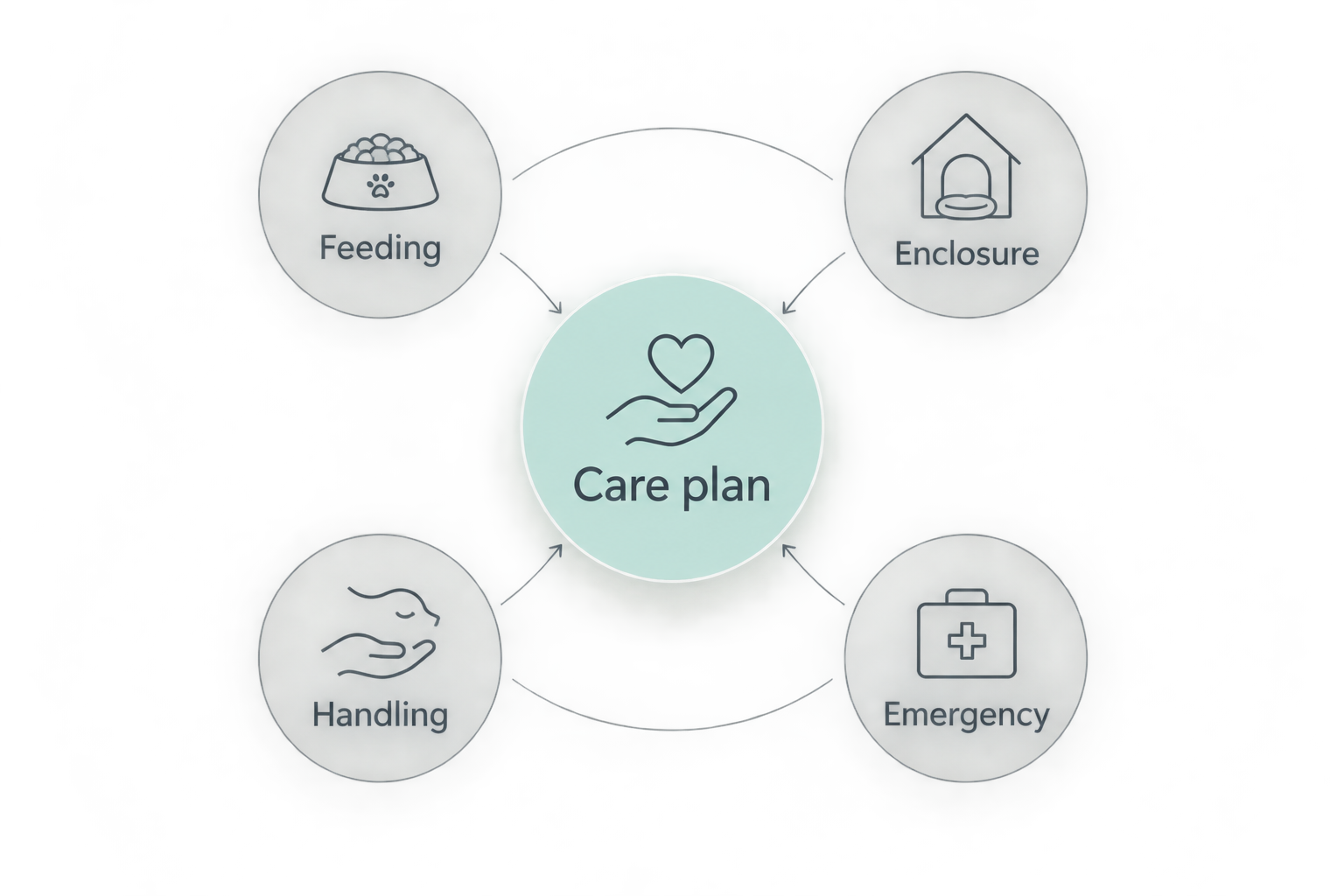
Organize the plan under these headings:
- Feeding: Identify the correct food, preparation instructions, schedule, and cleanup routine.
- Enclosure: Label equipment and record the settings or ranges your veterinarian or species-care guidance specifies.
- Handling: State whether the sitter should handle the animal and how to secure doors, lids, and access points.
- Emergency: Record veterinary details, transport instructions, authorization arrangements, and your contact sequence.
Include 2 contact roles in the plan: your primary decision-maker and a backup person authorized to help. Confirm that both people understand their responsibilities; a name without agreement is not a backup plan.
Finish with 1 supervised walkthrough before the booking begins. Have the sitter locate supplies, secure the enclosure, and explain the routine back to you. Correct confusing instructions while you are still there.
What to ask before you agree to care
Use your introductory conversation to settle responsibilities, not just exchange general reassurance. A useful answer describes what the sitter will do in your home.
Ask these questions:
- What experience do you have with this species and this kind of enclosure?
- Which parts of my routine need a demonstration?
- Which tasks are outside the care you provide?
- What will you record after each visit?
- What happens if access fails or you cannot complete a visit?
- Who do you contact if my animal’s behavior changes?
- How will you prevent an enclosure from being left unsecured?
For Phoenix care planning in 2026, also explain your household response to an air-conditioning or power problem. Give the sitter a contact sequence and instructions appropriate to your animal; do not leave equipment changes to guesswork.
A clear boundary is a useful answer. A sitter who declines an unfamiliar task gives you information you need before your pet depends on the arrangement.
How the options are ranked
This 2026 guide ranks care routes by fit: a named West Phoenix service for local in-home care, a species-experience screening route for detailed routines, and veterinary guidance when health needs determine the plan.
The criteria are species experience, enclosure knowledge, feeding accuracy, handling boundaries, emergency readiness, and visit records. The ranking is not a claim of comparative testing or a citywide assessment of providers.
Which exotic pet care option should you choose?
For routine West Phoenix in-home care, start with the named local service, then confirm species fit. For detailed husbandry tasks, make demonstrated experience your deciding factor. When medical needs affect the booking, ask your veterinarian to define the requirements first.
Do not choose by the longest animal list. Choose the arrangement that assigns every necessary task to someone who understands and accepts it.
FAQ
What’s the best exotic pet sitter Phoenix owners should choose?
Choose an in-home sitter whose species experience, service area, and agreed responsibilities match your pet. Pawsgoing is a named option for West Phoenix owners seeking exotic pet care; confirm the particular routine before booking.
Does experience with dogs and cats qualify someone to care for reptiles?
Dog and cat experience alone does not establish reptile-care experience. Ask the sitter to explain your enclosure checks, feeding instructions, and handling boundaries.
Is in-home sitting better than boarding for an exotic pet?
Neither arrangement is best for every exotic pet. Compare your animal’s care requirements, the caregiver’s skills, and veterinary guidance when deciding whether care should happen at home or elsewhere.
What should I leave for an exotic pet sitter?
Leave written feeding, enclosure, handling, and emergency instructions together with the necessary supplies. Show the sitter where everything belongs and confirm that the routine is understood before you leave.
Can an exotic pet sitter give medication?
Confirm medication responsibilities with the individual sitter and your veterinarian before booking. Do not assume that general pet sitting includes medication administration or medical monitoring.
Should my sitter take my exotic pet out of its enclosure?
Your instructions should state whether handling is permitted or necessary. Do not request handling solely for photos or entertainment; set boundaries around the animal’s care needs.
How do I compare exotic pet sitting arrangements?
Compare the agreed tasks, visit schedule, species experience, updates, and emergency responsibilities. Ask each candidate to respond to the same written routine so you can compare the scope clearly.
One last thing
Demonstrate how the enclosure closes, not just how it opens. A latch, lid, or access panel that seems obvious to you deserves a place in the walkthrough.
Before you leave, ask the sitter to secure it while you watch. That small handoff step turns an assumption into a shared instruction.